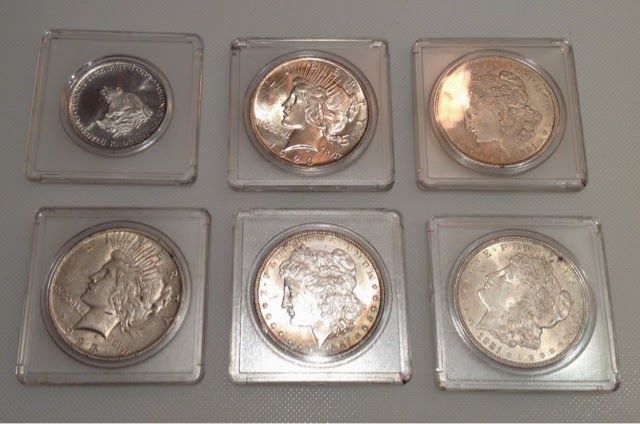
I then ran into my friend Rueben, who I laughingly and a bit reluctantly told about my find, and who then excitedly informed me that he often searched the change pocket himself and that a few weeks earlier had retrieved a large handful of silver dollars dating back to the 1800's. Dear god, I thought, the machine rejects basically everything I spend hours digging in the dirt for. Since then, I make sure to casually wander by the change machine every time I shop, peeking discreetly into or running my fingers through the change rejection pocket, and usually coming up with something. Often, it's just a Canadian dime or a few beat up pennies but sometimes it is more and on occasion, it's a jackpot. Yesterday, there was just one coin, but one I had never seen, a gold colored 10 Euro cent piece with a great picture of the amazing Cervantes, author of "Don Quixote", one of the greatest and most timeless pieces of literature ever written. I have been keeping track, and in the last month or so I have pulled over twenty dollars out of that one machine and the numbers continue to grow. No handful of 19th Century silver dollars yet, but it's gonna happen. I can feel it.
Showing posts with label Aaron Marcy. Show all posts
Thursday, June 23, 2016
Quixotic Changes
So, I probably shouldn't tell anyone this, but stumbled on a humorous and odd little method of finding rare, foreign, spare, and basically free source of change. This is the change pocket on the lower face of those large change counting machines that are located in most modern grocery stores. You know the ones, those big green things that we use now to take the place of what once involved all of us poor kids siting around the kitchen table counting out pennies and pushing them into paper coin tubes with pencil erasers so we could afford to buy groceries and eat food. Well, the first incident involved me dumping a jar of loose change into one of these machines and looking down to find that someone else had left a great deal of coins in the change return pocket, and when I say a great deal of coins I mean like over ten dollars in change, one of which was a silver dime from 1947, a 1919 wheat penny and a handful of quarters from Bermuda. I just thought it was funny and I took it to the front desk, where I was told that this happens often and to go ahead and keep it.
Wednesday, June 4, 2014
Sidewalk Treasures
The more I do this, the more I am approached by friends and strangers who have their own treasure hunting stories, from mystery objects found beachcombing to accidental discoveries like the used car coin collection I posted last month. Yesterday, I ran into my good friend Ronald at the new Owl and Turtle Coffee Shop, and he pulled out a little tattered blue coin purse. He plopped it into my palm and I was immediately impressed by its unusual heaviness. "Years ago, I lived in New York City," he said in his thick Dutch accent. "One day I was walking down the street and I found this little change purse just sitting on the sidewalk beside a trash can."
Inside, I found about a dozen medium sized musket balls, two larger walnut sized grape shot or musket balls, and forty or so heavily worn pewter buttons that were obviously of military origin. Many of them bore numbers on their faces and I assumed from my own past finds that they were Civil War relics. However, after talking with my friend and co-worker, Mark Becker, who has a pretty expansive knowledge of that sort of thing, and doing a little research online, I have determined they are actually Revolutionary War artifacts. They are made of pewter, with rusty iron loops on the backs, and some were probably silver plated, with the numbers representing the regiments.
I cannot imagine what this little purse was doing on the sidewalks of NYC. Perhaps some desperate individual stole it thinking it was full of money and disposed of it just as quickly when he or she realized it was just filled with worthless lead balls and nasty broken buttons. Little did they know, they were actually tossing aside an incredible little collection of important relics dating back to America's war for independence. I would be excited to find any one of these buttons, never mind an entire sack of them. Once again, it proves that "treasure" can be found anywhere, at any time, as long as you keep your eyes open.
Tuesday, May 20, 2014
Thursday, April 10, 2014
Icons and Symbols
The ground is starting to thaw. Still frozen in most places, there are spots in the sun where I can dig down twelve inches without hitting ice. A few visits to these soft spots in a local park have yielded up a couple of nice finds: a pre-war nickel, the second Buffalo of the year, a funky jeweled star that looks like a cheap carnival prize, a beautiful silver Catholic amulet marked "Hayward Sterling 1830", and my favorite, an amazing piece of Victorian jewelry in the form of a lion headed copper ring. The gold plating is still visible in the grooves, a diamond in the mouth, and one ruby eye. This immediately became one of my favorite finds ever.
Also, my buddy Matt Pollis came up with a really interesting brass plaque labeled "Milling Cylinder 1908". We both did a little online research and couldn't figure out what it was from, ultimately assuming it was personally engraved by someone, probably for their lobster boat.
Saturday, April 5, 2014
Hi-Tech Metal Detecting Supercomputers
I picked up this here mean machine a few weeks ago for a couple of bucks at a yard sale and I finally got a chance to clean it up and fire it up. I love it. This is a perfect example of what people were hunting with forty or fifty years ago. Note the ground balancing knob, which is a far cry from the automatic ground balancing of today's remarkably advanced devices. I'm pretty sure the old Search Master was the predecessor to the modern Bounty Hunter brand metal detector. Anyway, I just love the look of this vintage beauty, and I think I see a tattoo in that Texas logo.
Wednesday, March 26, 2014
Coin Collection Treasure Find
I remember Karl Von Mueller writing in "Treasure Hunter's Manual #7" about the wildly various places one can find hidden treasure troves, from the more commonly known hiding spots like floorboards in old houses and the insides of old trees to unusual places like windowsills and the undersides of old bureaus and the insides of lamps. Well, one of the hiding spots he mentioned was automobiles. Apparently, people's cars and trucks are a fairly common place for them to hide things. If you think about it, it makes perfect sense. We spend a lot of time in our autos and they tend to not be out of our sight for very long. Hiding spots inside of automobiles can vary from wheel wells to the insides of seats and even deeply thought out and executed locations buried far inside of exhaust systems.
So, I was thrilled to hear a story yesterday from a close friend and co-worker (who shall remain nameless) about a coin collection he found hidden inside of a used car he bought. The car was over ten years old when he purchased it and he had owned the thing for at least a year before he discovered two narrow blue plastic boxes hidden under a flap of upholstery in the rear. Inside of the boxes, he found a beautiful collection of rare and foreign coins. The collection contains a nice lot of old silver dollars and half dollars, a roll of silver quarters, a half roll of silver dimes, commemorative coins, some fine British coins, a few large cents, and a wide variety of foreign pieces. Probably the most interesting item is a tiny little silver 1889 Queen Victoria "Jubilee Head" Maundy Penny, whose value I estimate to be between 125 and 150 dollars. Note the extremely diminutive size of the Jubilee Head when it is placed beside a penny in the final pic.
My friend is now considering selling the whole lot, so I stayed up last night and tried to price them out. I am certainly no experienced numismatist, but as far as I can tell, the collection is worth somewhere between 500 and a 1000 dollars, which is probably more than he paid for the car. And to set the record straight, the original owners of the car were ultimately sought out and knew nothing of the coins.
If anybody needs to get ahold of me this week, I will be in my driveway, tearing my truck apart piece by piece...
Saturday, March 15, 2014
Uncle Pirate's Treasure
So, my friends Ginny and Dave told me that Ginny's uncle had given her a tin of old coins that he had found around Camden and surrounding towns over the years. Now, keep in mind that he wasn't metal detecting. I got the impression he was just walking around picking them up. She brought the tin over yesterday and here are a few shots. There are some really interesting coins: an enormous 1828 Italian cent, a lovely 1840 Nova Scotia large cent with the poppy on rear (found one myself on North Haven), interesting carved Canadian large cent, 1865 2 cent (haven't found one yet), 1844 one shilling silver, some nice small silvers, and of course... the damned reale. The reale deale. Piece of eight. Spanish silver. Small piece, but it's a piece. I want it. I wish I had found it. I offered to buy it. I know it's not worth a lot, but it's beautiful. I want to swallow it. Keep it in my stomach for good luck.
Wednesday, March 5, 2014
Some Old Winter Bottles
Here are a few old bottles I found this week. The large green wine or champagne bottle was found wedged between some rocks at Fort Popham at low tide. We had a frigid day last week and I was unable to finish the day at work, so I drove by myself down to Popham Beach and Fort Popham. I nearly froze to death climbing around on the icy rocks behind the Fort, looking for cannonballs and old bottles. I didn't find any balls, but I did find the bottle--note the nice deep kick-up in the bottom, and the fantastic sea glass effect to the edges from a 100 years under salt water--and #4 lead plummet to add to my lead plummet collection.
The little aqua blue was found in Camden, at the bottom of an eight foot hole that had just been excavated for concrete. The embossing on the sides reads "3 in 1 Oil Co." I had just finished reading "Bottle Collecting in New England" by John Adams that morning, so I was excited to put its finer details up to what I had learned from the book.
And the little brown bottle was found at a Camden home while my good friend Ronald Van Heesjwick and I were doing some renovations. It's original purpose is a mystery, but I imagine it had something to do with medicine.
I'm not going to do a review here, but I enjoyed the Adams book. It's not large, with only 25 pages of text and 100 pages of bottle pics and prices, but there were a few tidbits of important bottle hunting info to be gleaned, and the 1960's photos of Adams searching the New England forest for bottles with his wife and sons are amazing. Definitely worth a quick peruse if you get the chance.
Subscribe to:
Posts (Atom)